Target New ArrivalsBack to SchoolCollegeClothing, Shoes & AccessoriesHome & DecorKitchen & DiningOutdoor Living & GardenGroceryHousehold EssentialsBabyBeautyPersonal CareSports & OutdoorsHealthWellnessSchool & Office SuppliesToys & GamesElectronics & TechVideo GamesMovies, Music & BooksParty SuppliesGift IdeasGift CardsPetsUlta Beauty at TargetShop by CommunityTarget OpticalDealsClearanceNew ArrivalsBack to SchoolCollegeTop DealsTarget Circle DealsWeekly AdShop Order PickupShop Same Day DeliveryRegistryRedCardTarget CircleFind Stores
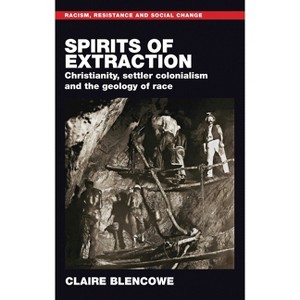
Spirits of Extraction - (Racism, Resistance and Social Change) by  Claire Blencowe (Hardcover) - 1 of 1

Spirits of Extraction - (Racism, Resistance and Social Change) by Claire Blencowe (Hardcover)

$126.49Save $3.51 (3% off)

In Stock

Free & easy returns
Free & easy returns
Return this item by mail or in store within 90 days for a full refund.
Eligible for registries and wish lists

About this item

Highlights

  • Spirits of extraction revisits the troubling history of socially reformist, ostensibly anti-racist, Christianity and its role in the expansion of the extractive industries, British imperialism, and settler colonialism.
  • About the Author: Claire Blencowe is Professor of Sociology at the University of Warwick
  • 240 Pages
  • Social Science, Sociology
  • Series Name: Racism, Resistance and Social Change

Description


About the Book


An exploration of the historical intersections of the mining industry, Methodist evangelical Christianity, civilisational education, and the modern metaphysics of race. Contributing to theories of race and racism by insisting on the enduring role of religious biopolitics and Christianising education, whilst expanding on the 'geology of race'.


Book Synopsis


Spirits of extraction revisits the troubling history of socially reformist, ostensibly anti-racist, Christianity and its role in the expansion of the extractive industries, British imperialism, and settler colonialism. The book explores key moments in the history of Methodism and the evangelical movement. Colonial fears, and the attempt to 'civilise savages', were crucial to the movement's foundation in eighteenth-century industrialising Bristol, England. Through the culture of the Cornish mining diaspora of the nineteenth century, Methodism enmeshed with all the complexity of race and labour-structures of the British empire. At the same time, in Anishinaabewaki/Upper Canda/Ontario, Methodist missionaries laid the foundation of abusive education and racialised ideas of redemption that both enable and sacralise the mining industry. Through these histories of our present, the book theorises the relation of religion and education to racism, modernity, biopower, extractivism, and the geology of race.


From the Back Cover


Spirits of extraction reexamines the entangled histories of racism, Christianity, and humanitarian biopolitics in the long nineteenth century, offering a fresh perspective on the intersection of extractive industries, evangelical revivalism, and the violent civilisational metaphysics of race. Moving across eighteenth-century industrialising Bristol, the Cornish mining diaspora of the expanding British Empire, and the contested lands of Anishinaabewaki/Upper Canada/Ontario, this book traces how evangelical Christianity helped shape the colonial world through processes of extraction - of resources, bodies, and souls.

Blending historical narrative with critical theory, the book makes two key interventions. Firstly, it repositions colonial religion and educational/cultural racism as central to the biopolitical project, analysing the wounding effects of 'truly Christian' education and exorcism in evangelical subject formation. Secondly, it extends thinking on the 'geology of race' by highlighting the extractive industries as the affective scene through which modern evangelical Christianity came to life. By showing how mining and missionary practices co-constituted racial hierarchies and modes of sovereignty, Spirits of extraction offers a major contribution to thinking about the politics of life and resource extraction. Evangelical experiences of salvation, exorcism, and the transformative power of faith, the book argues, resonate through geological consciousness and the logics of extraction, sustaining a quasi-divine force that continues to structure lives and landscapes today.


Review Quotes


'In this critically important and theoretically daring book, Claire Bencowe takes us on a journey through places that appear disconnected yet are deeply entangled. She skilfully traces links between her own situated history within colonial webs of extraction, the rise of Methodism in Bristol and the UK, Cornish miners and migrants, and residential schools on Indigenous lands in Canada. Beautifully written, the book grounds the concept of a 'geology of race' with audacity, making it an essential guide for anyone seeking to understand the entanglements of planetary extraction, Christianity and British colonialism.'
Dr Negar Elodie Behzadi, Editor of Extraction/Exclusion: Beyond Binaries of Exclusion and Inclusion in Natural Resource Extraction (Bloomsbury, 2024)

'Christianity, Settler Colonialism and the Geology of Race is compact in form but expansive in scope. It brings together theology, political economy, and the lived realities of migration and extraction in a way that challenges any neat separation between religious history, the metaphysics of racism, and colonial capitalism, showing how Methodism underpinned the genocidal destruction of Indigenous peoples and their rights to land, rocks, animals, and ancestral spirits, while simultaneously policing Cornish miners to prevent them from turning to alcohol. The prose is lucid, the research meticulous, and the argument both unsettling and necessary.'
Özge Onay, Ethnic and Racial Studies

'The role of religiously charged racism does indeed demand sustained critical attention, not least where and when it fused with other powerful forces that have damaged and decimated human communities and cultures. Blencowe's hard-hitting book is a welcome addition to this necessary critical endeavour.'
Diarmid A. Finnegan, Journal of Historical Geography

'
Moving from Bristol and Cornwall to Australia, Africa and the Americas, this book tells a transnational story of racism and cruelty, underpinned by 'good intentions' and desire for redemption. Whether it is Bristol city council' attempt to move on from its history of slavery, Methodist clerics' management of residential schools, or the exclusionary labour policies of Cornish miners who were themselves racialised as 'Blackened', Claire Blencowe shows how even groups opposed to, and marginalised, by empire inflicted colonial violence onto Indigenous populations. At its core, the book asks whether race and not class functions as the primary means of socio-economic oppression.'
Dr. Angela Last, International Research Fellow (University of Bonn)

'The book powerfully demonstrates how material extraction - of minerals, labour, and land - was inextricably linked to the racialised Christianising and colonial orders that shaped modernity. Its greatest strength lies in tracing the temporal depth and spatial reach of these entanglements, connecting Britain's industrial heartlands to its settler colonies overseas.'
Mitsutoshi Horii, Journal of Political Power

'The second exceptional contribution of Blencowe's work lies in the way her theorizations expand the concept of geology of race (Yussof, 2018), challenging some of its more universalist tendencies. The author embeds the concept developed by the geographer Kathryn Yussof in a traceable historical process documented through deep archival and empirical research. In doing so, she contributes to decolonising this framework, which is sometimes articulated in abstraction or theoretical isolation.'
Negar Elodie Behzadi, Interrogations Book Forum (Institute for Contemporary Critical Thought)

'Exposes the redemptive futures of settler colonial extractivism and dispossession at the level of discourse, land, race, religion, gender and sexuality.'
Goldie Osuri, Interrogations Book Forum (Institute for Contemporary Critical Thought)

'Claire makes a very significant contribution to 'material eco/geo-feminism' with her detailed historical work on Methodism, race and mining, articulating what she calls its 'evangelical extractivist-exorcist aesthetic'. She shows how the modern ideology of race came to have a vertical coding, underwritten by geological ideas of the superposed layers of the lithosphere, with lower layers older, darker, more primitive, and newer layers exposed to the light.'
Bronislaw Szerszynski, Interrogations Book Forum (Institute for Contemporary Critical Thought)

'A genuine inspiration for those of us pondering how to engender forms of collective respiration - political, spiritual, planetary - beyond the logics of redemption, salvation, and damnation, in the enduring violence and dislocations that make live-in under duress on an earth at loose ends with itself.'
Martin Savransky, Interrogations Book Forum (Institute for Contemporary Critical Thought)

'The author's central argument is that Methodism exemplified the perversion through which European evangelical Christianity claimed to be offering salvation, education and healthcare through its missionary
endeavours, but in practice used such tools to facilitate the colonial subjugation of Indigenous and Black people and the looting of their mineral and other resources. In Blencowe's words: "We might understand Methodism as a plane of biopolitical subjectification, helping to secure the attachment of souls to quasi-transcendental life
forces, as well as furnishing the emergent bourgeois and colonial ruling classes with the narratives through which they claimed authority as care-takers of life."'
Proceedings of the Wesley Historical Society


About the Author


Claire Blencowe is Professor of Sociology at the University of Warwick
Dimensions (Overall): 9.21 Inches (H) x 6.14 Inches (W) x .56 Inches (D)
Weight: 1.13 Pounds
Suggested Age: 22 Years and Up
Series Title: Racism, Resistance and Social Change
Sub-Genre: Sociology
Genre: Social Science
Number of Pages: 240
Publisher: Manchester University Press
Theme: Social Theory
Format: Hardcover
Author: Claire Blencowe
Language: English
Street Date: March 18, 2025
TCIN: 94309204
UPC: 9781526176509
Item Number (DPCI): 247-47-3828
Origin: Made in the USA or Imported
If the item details aren’t accurate or complete, we want to know about it.

Shipping details

Estimated ship dimensions: 0.56 inches length x 6.14 inches width x 9.21 inches height
Estimated ship weight: 1.13 pounds
We regret that this item cannot be shipped to PO Boxes.
This item cannot be shipped to the following locations: American Samoa (see also separate entry under AS), Guam (see also separate entry under GU), Northern Mariana Islands, Puerto Rico (see also separate entry under PR), United States Minor Outlying Islands, Virgin Islands, U.S., APO/FPO, Alaska, Hawaii

Return details

This item can be returned to any Target store or Target.com.
This item must be returned within 90 days of the date it was purchased in store, delivered to the guest, delivered by a Shipt shopper, or picked up by the guest.
See the return policy for complete information.

Additional product information and recommendations
Discover more options

Skip to next section

Best-selling All Book Genres

Skip to next section

Get top deals, latest trends, and more.