Target New ArrivalsBack to SchoolCollegeClothing, Shoes & AccessoriesHome & DecorKitchen & DiningOutdoor Living & GardenGroceryHousehold EssentialsBabyBeautyPersonal CareSports & OutdoorsHealthWellnessSchool & Office SuppliesToys & GamesElectronics & TechVideo GamesMovies, Music & BooksParty SuppliesGift IdeasGift CardsPetsUlta Beauty at TargetShop by CommunityTarget OpticalDealsClearanceNew ArrivalsBack to SchoolCollegeTop DealsTarget Circle DealsWeekly AdShop Order PickupShop Same Day DeliveryRegistryRedCardTarget CircleFind Stores
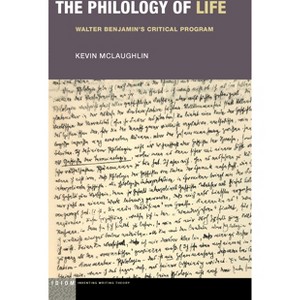
The Philology of Life - (Idiom: Inventing Writing Theory) by  Kevin McLaughlin (Paperback) - 1 of 1

The Philology of Life - (Idiom: Inventing Writing Theory) by Kevin McLaughlin (Paperback)

$35.00

In Stock

Free & easy returns
Free & easy returns
Return this item by mail or in store within 90 days for a full refund.
Eligible for registries and wish lists

About this item

Highlights

  • The Philology of Life retraces the outlines of the philological project developed by Walter Benjamin in his early essays on Hölderlin, the Romantics, and Goethe.
  • About the Author: Kevin McLaughlin was Dean of Faculty at Brown University from 2011-22.
  • 208 Pages
  • Literary Criticism, Semiotics & Theory
  • Series Name: Idiom: Inventing Writing Theory

Description


Book Synopsis


The Philology of Life retraces the outlines of the philological project developed by Walter Benjamin in his early essays on Hölderlin, the Romantics, and Goethe. This philological program, McLaughlin shows, provides the methodological key to Benjamin's work as a whole.

According to Benjamin, German literary history in the period roughly following the first World War was part of a wider "crisis of historical experience"--a life crisis to which Lebensphilosophie (philosophy of life) had instructively but insufficiently responded. Benjamin's literary critical struggle during these years consisted in developing a philology of literary historical experience and of life that is rooted in an encounter with a written image.

The fundamental importance of this "philological" method in Benjamin's work seems not to have been recognized by his contemporary readers, including Theodor Adorno who considered the approach to be lacking in dialectical rigor. This facet of Benjamin's work was also elided in the postwar publications of his writings, both in German and English. In recent decades, the publication of a wider range of Benjamin's writings has made it possible to retrace the outlines of a distinctive philological project that starts to develop in his early literary criticism and that extends into the late studies of Baudelaire and Paris. By bringing this innovative method to light this study proposes "the philology of life" as the key to the critical program of one of the most influential intellectual figures in the humanities.


From the Back Cover


"McLaughlin's book is a model of literary studies in which the idea of life becomes a primary focal point. This life is neither the typical material of literary biography nor the 'mere life' that comes under discussion in assessments and critiques of biopolitics. By presenting the question of life as fundamentally a matter of reading, McLaughlin's biophilology makes an invaluable contribution to our understanding of Benjamin's early work as well as the theory of literature in general."--Peter Fenves, Northwestern University

"This is a rare book that addresses Benjamin as reader of literature, as a failed academic Literaturwissenschaftler but a highly successful, even prophetic reader. The manuscript is marked by a lapidary quality that speaks to the expertise and depth of the author's approach."--Leif Weatherby, New York University

The Philology of Life retraces the outlines of the philological project developed by Walter Benjamin in his early essays on Hölderlin, the Romantics, and Goethe. This philological program. McLaughlin shows, provides the methodological key to Benjamin's work as a whole.

According to Benjamin, German literary history in the period roughly following the first World War was part of a wider "crisis of historical experience"--a life crisis to which Lebensphilosophie (philosophy of life) had instructively but insufficiently responded. Benjamin's literary critical struggle during these years consisted in developing a philology of literary historical experience and of life that is rooted in an encounter with a written image. By bringing this innovative method to light this study proposes "the philology of life" as the key to the critical program of one of the most influential intellectual figures in the humanities.

Kevin McLaughlin is Dean of Faculty at Brown University, where he serves as George Hazard Crooker University Professor of English, Comparative Literature, and German Studies. He is the author of three books and co-translator of Walter Benjamin's Arcades Project.


Review Quotes


This book takes up a worthy place among a strong flow of books that bring an impressive weight to bear on Walter Benjamin's work from every plausible quarter.-- "Monatshefte"

McLaughlin's book is a model of literary studies in which the idea of life becomes a primary focal point. This life is neither the typical material of literary biography nor the 'mere life' that comes under discussion in assessments and critiques of biopolitics. By presenting the question of life as fundamentally a matter of reading, McLaughlin's biophilology makes an invaluable contribution to our understanding of Benjamin's early work as well as the theory of literature in general.---Peter Fenves, Northwestern University

This is a rare book that addresses Benjamin as reader of literature, as a failed academic Literaturwissenschaftler but a highly successful, even prophetic reader. The manuscript is marked by a lapidary quality that speaks to the expertise and depth of the author's approach.---Leif Weatherby, New York University


About the Author


Kevin McLaughlin was Dean of Faculty at Brown University from 2011-22. He is George Hazard Crooker University Professor of English, Comparative Literature, and German Studies at Brown. He is the author of Poetic Force: Poetry after Kant (Stanford University Press, 2014), Paperwork: Literature and Mass Mediacy in the Age of Paper (University of Pennsylvania Press, 2005), and Writing in Parts: Imitation and Exchange in Nineteenth-Century Literature (Stanford University Press, 1995), and the co- translator with Howard Eiland of Walter Benjamin's Arcades Project (Harvard University Press, 1999).
Dimensions (Overall): 8.5 Inches (H) x 5.5 Inches (W) x .49 Inches (D)
Weight: .61 Pounds
Suggested Age: 22 Years and Up
Number of Pages: 208
Genre: Literary Criticism
Sub-Genre: Semiotics & Theory
Series Title: Idiom: Inventing Writing Theory
Publisher: Fordham University Press
Format: Paperback
Author: Kevin McLaughlin
Language: English
Street Date: January 17, 2023
TCIN: 1011501532
UPC: 9781531501693
Item Number (DPCI): 247-39-9568
Origin: Made in the USA or Imported
If the item details aren’t accurate or complete, we want to know about it.

Shipping details

Estimated ship dimensions: 0.49 inches length x 5.5 inches width x 8.5 inches height
Estimated ship weight: 0.61 pounds
We regret that this item cannot be shipped to PO Boxes.
This item cannot be shipped to the following locations: American Samoa (see also separate entry under AS), Guam (see also separate entry under GU), Northern Mariana Islands, Puerto Rico (see also separate entry under PR), United States Minor Outlying Islands, Virgin Islands, U.S., APO/FPO, Alaska, Hawaii

Return details

This item can be returned to any Target store or Target.com.
This item must be returned within 90 days of the date it was purchased in store, delivered to the guest, delivered by a Shipt shopper, or picked up by the guest.
See the return policy for complete information.

Additional product information and recommendations

Discover more options

Skip to next section

Best-selling Books

Skip to next section

Get top deals, latest trends, and more.